Fall 2026 · Code, 3D & film
Spaceflight, Rendered
A music video about spaceflight, built entirely in code.
No animation software and no keyframes. Rocket dimensions become geometry, geometry becomes scenes, and every one of the 8,158 frames is computed from a single number: the time in the song.
Watch the film ↓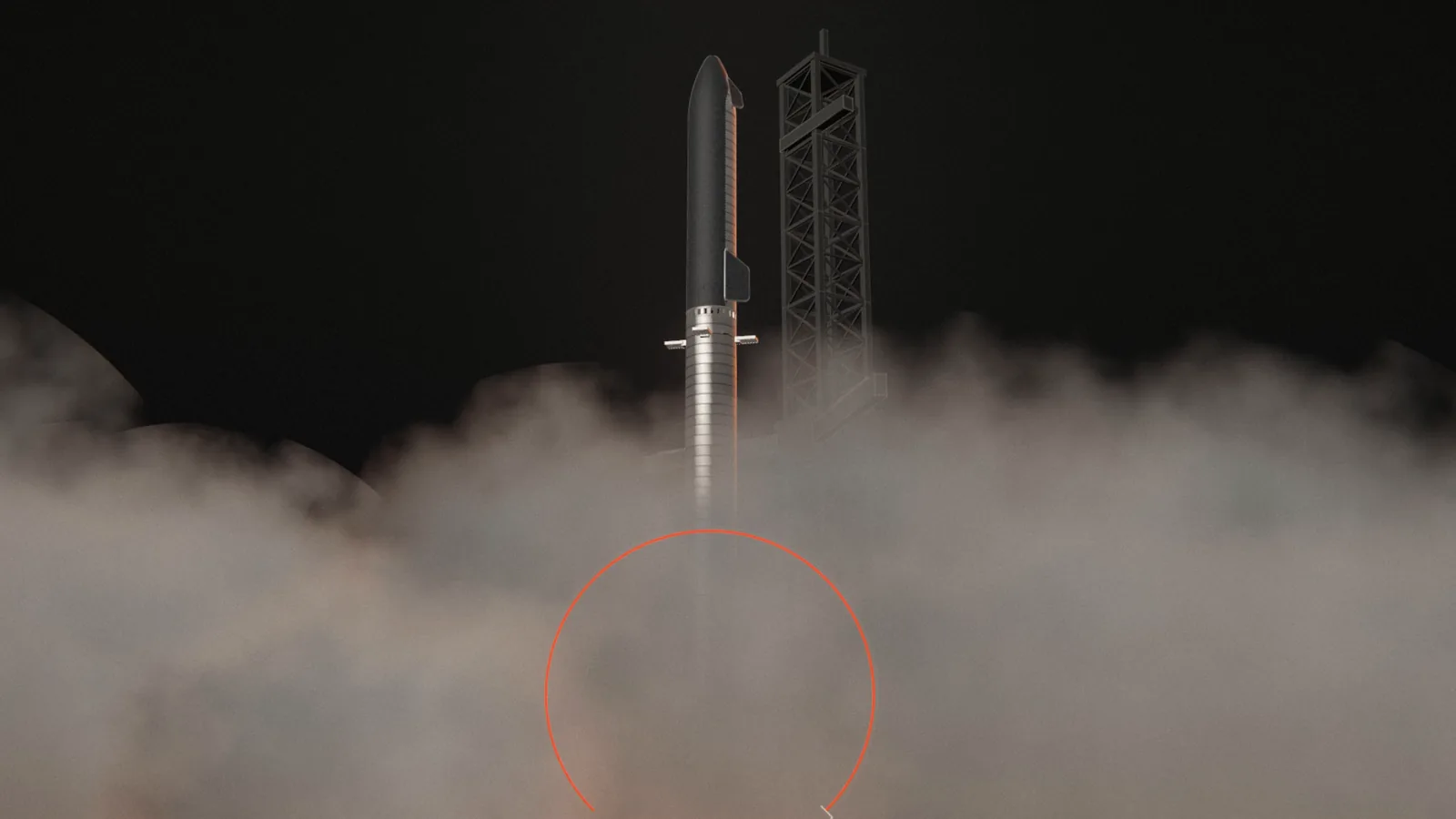
- Film
- 2 min 16 s · 8,158 frames
- Format
- 1920 × 1080 at 60 fps
- Edit
- 38 shots in 8 sections
- Project code
- 10,018 lines of TypeScript
Stills from the film
Inside the film.
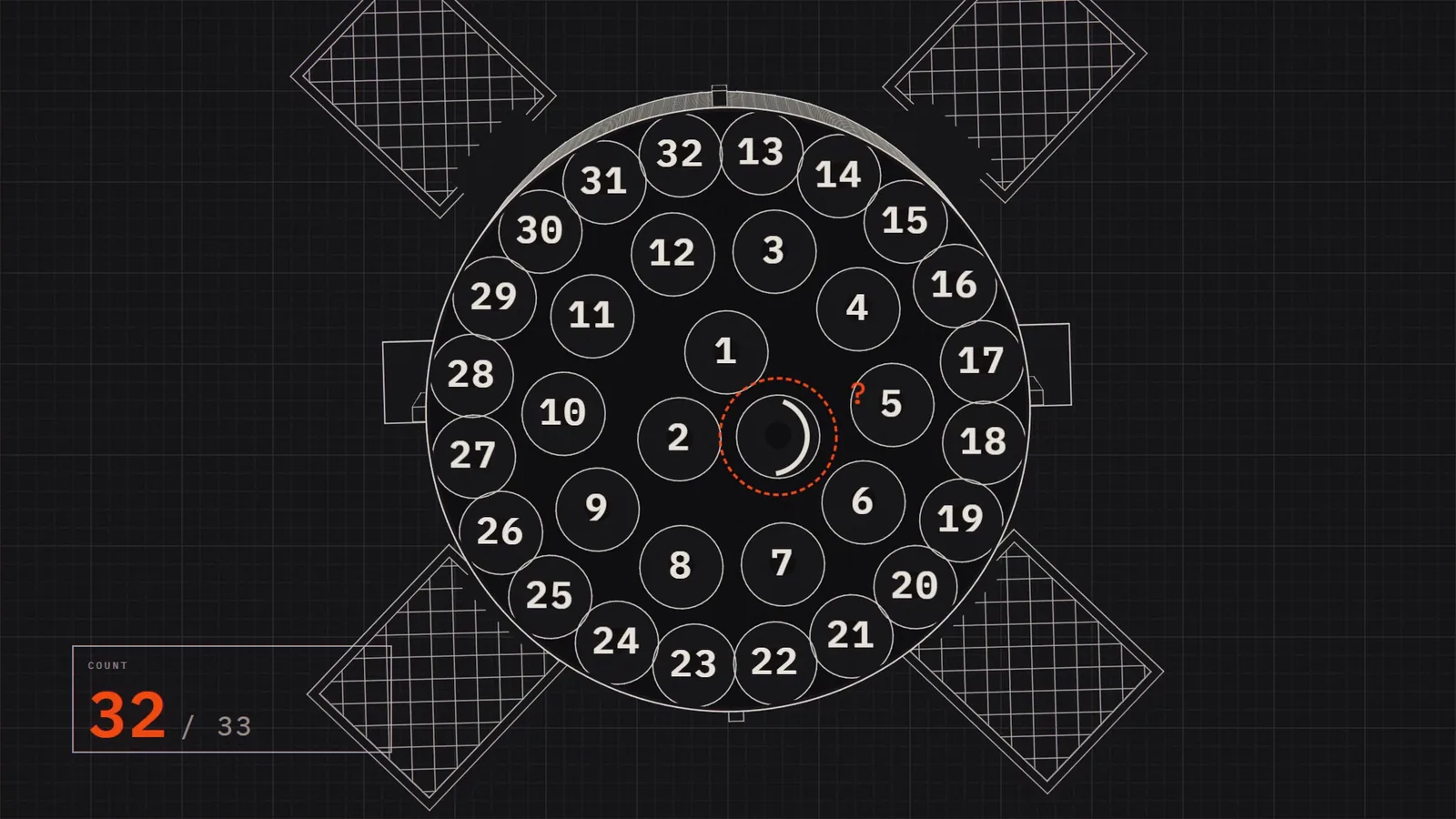
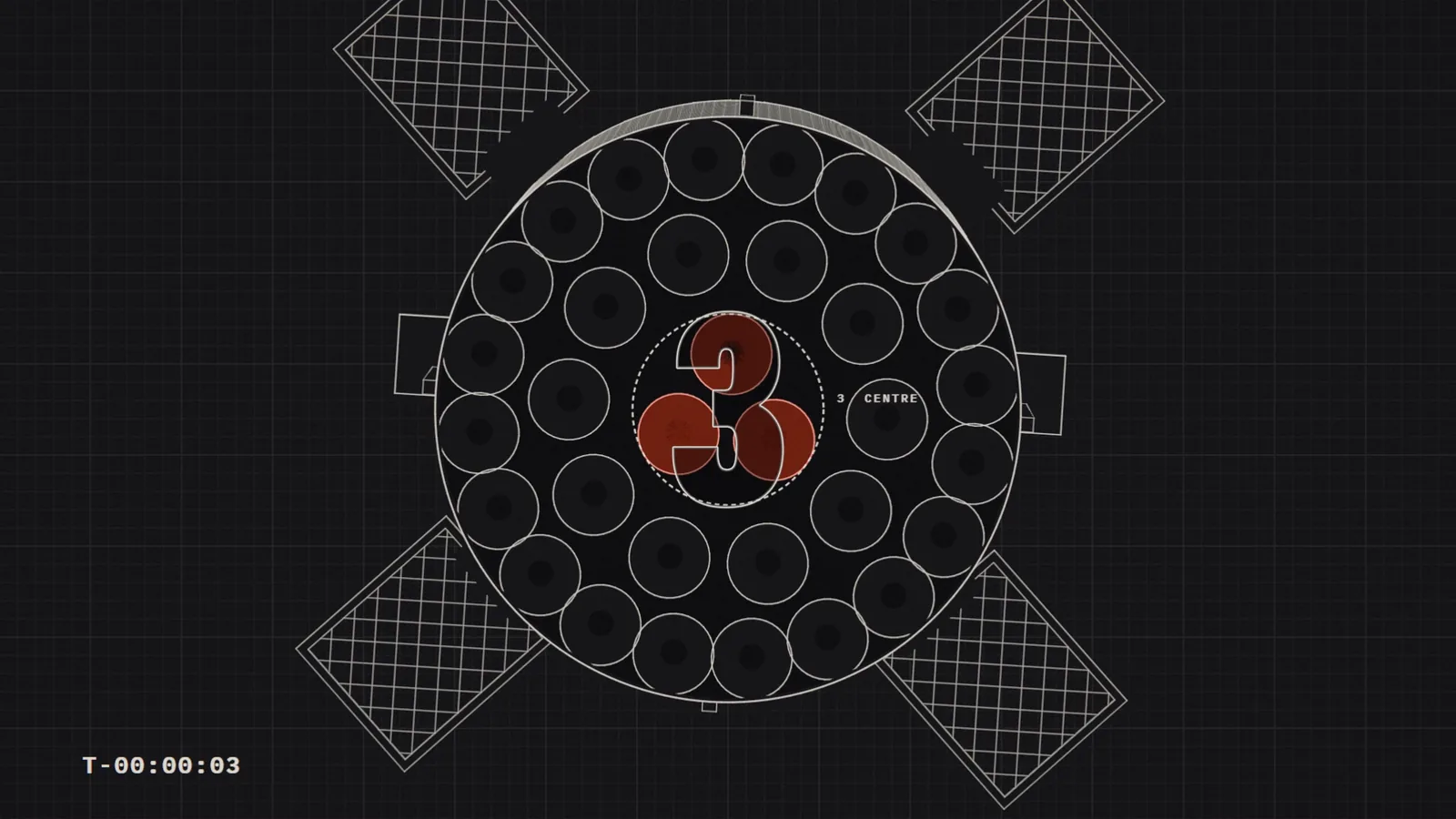
The 33 engines of Super Heavy, counted one by one.
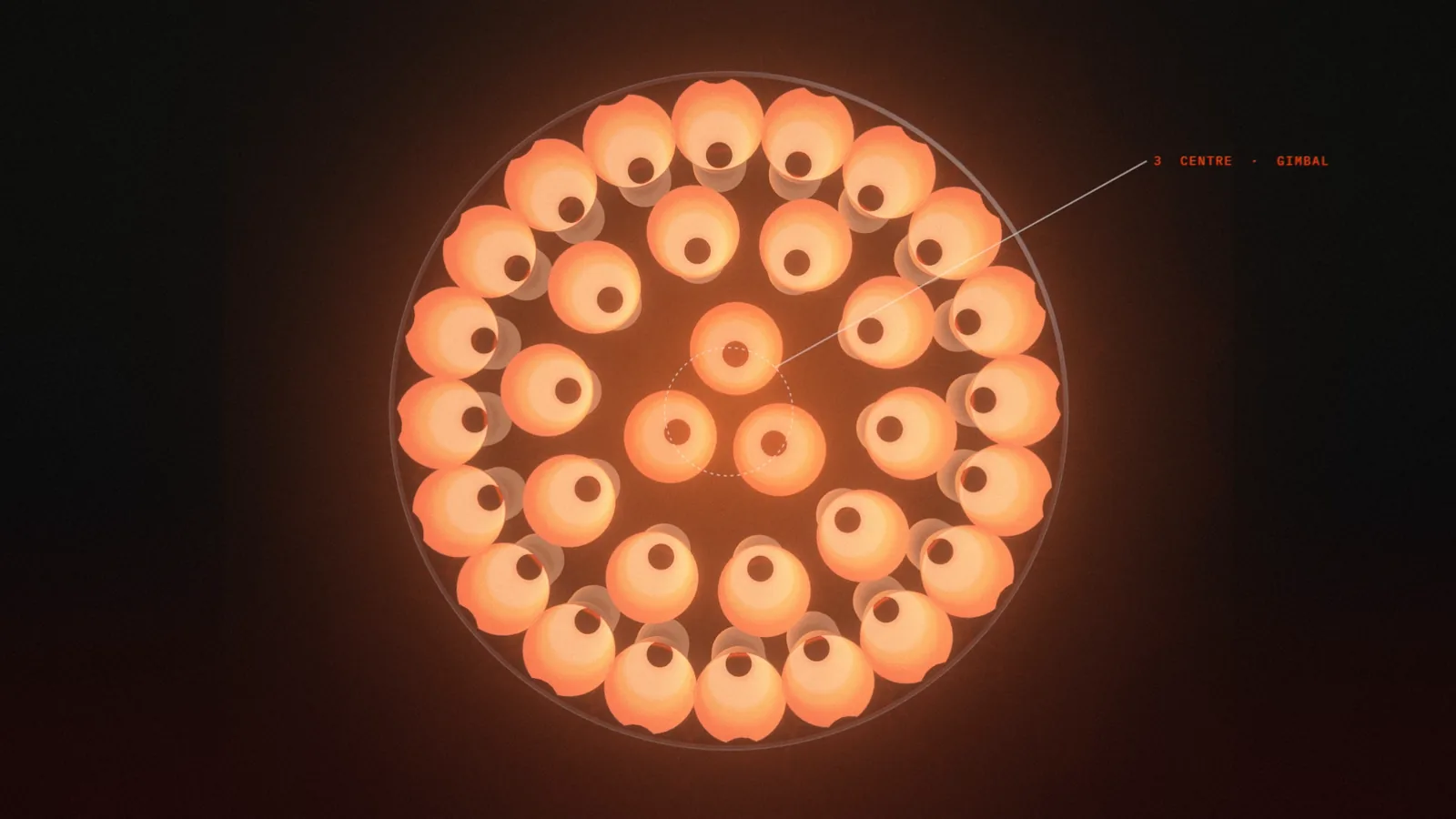
The engine cluster lit, seen from below.
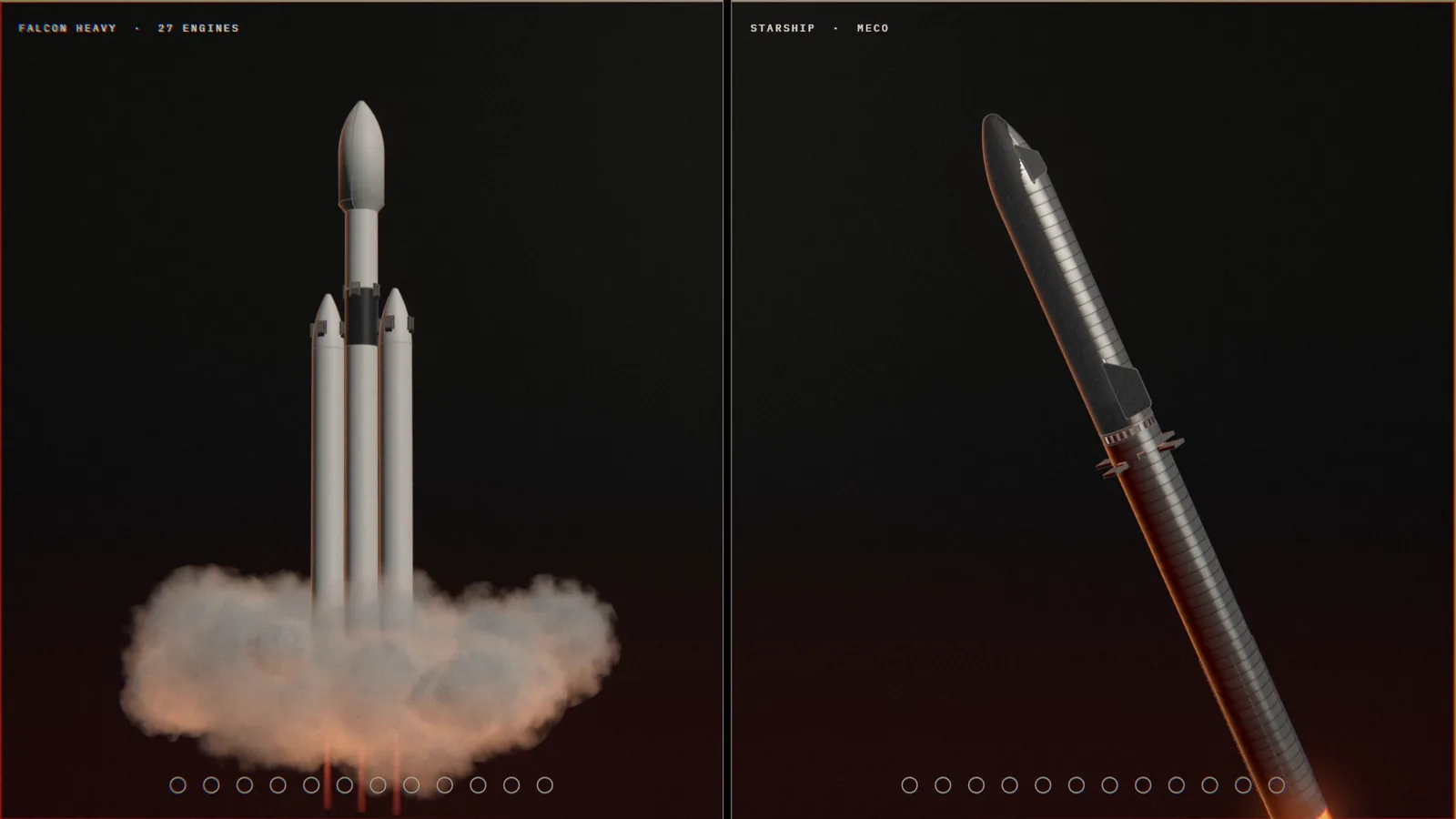
Falcon Heavy and Starship in split frames.
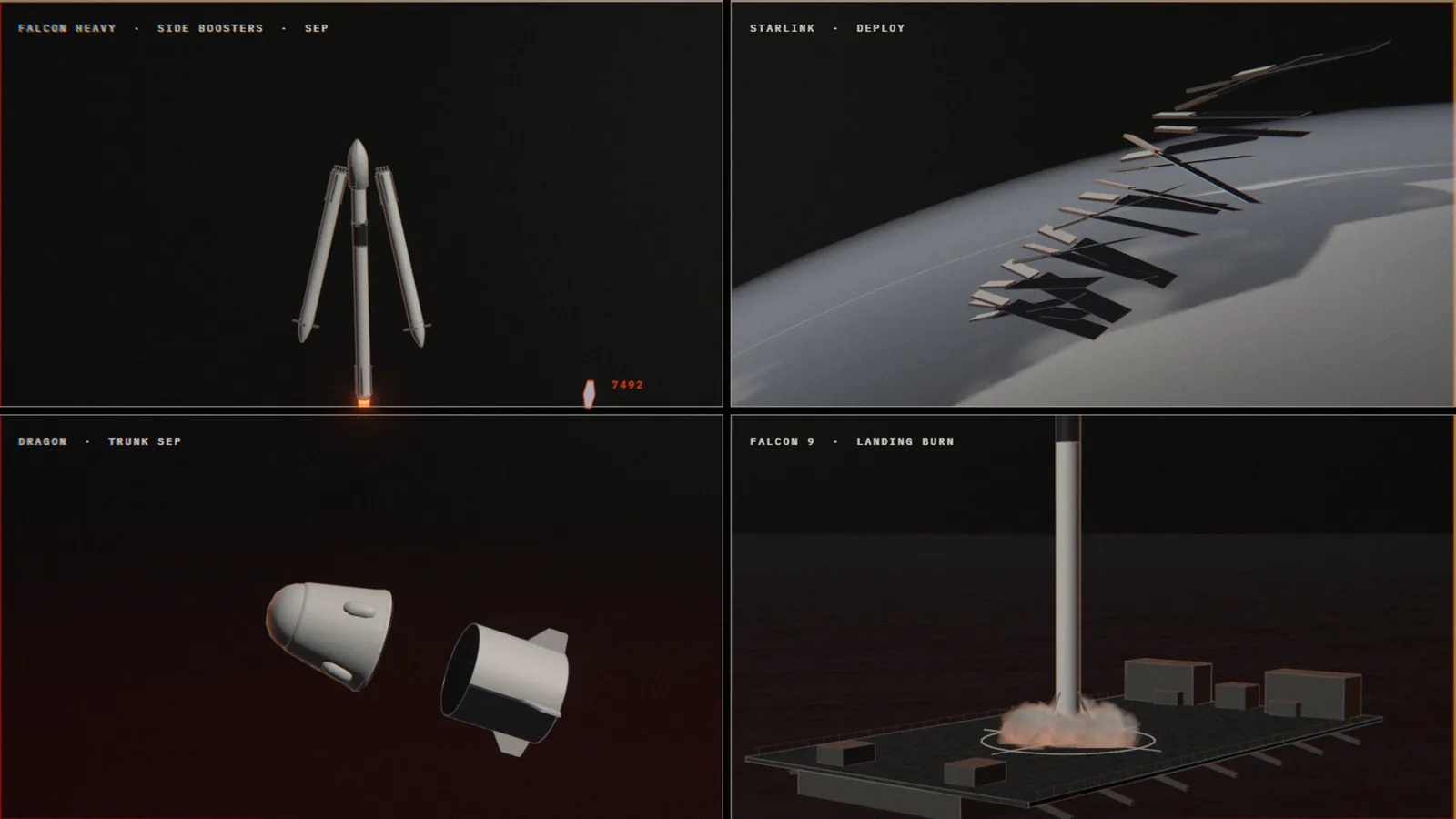
Four vehicles in four panels.
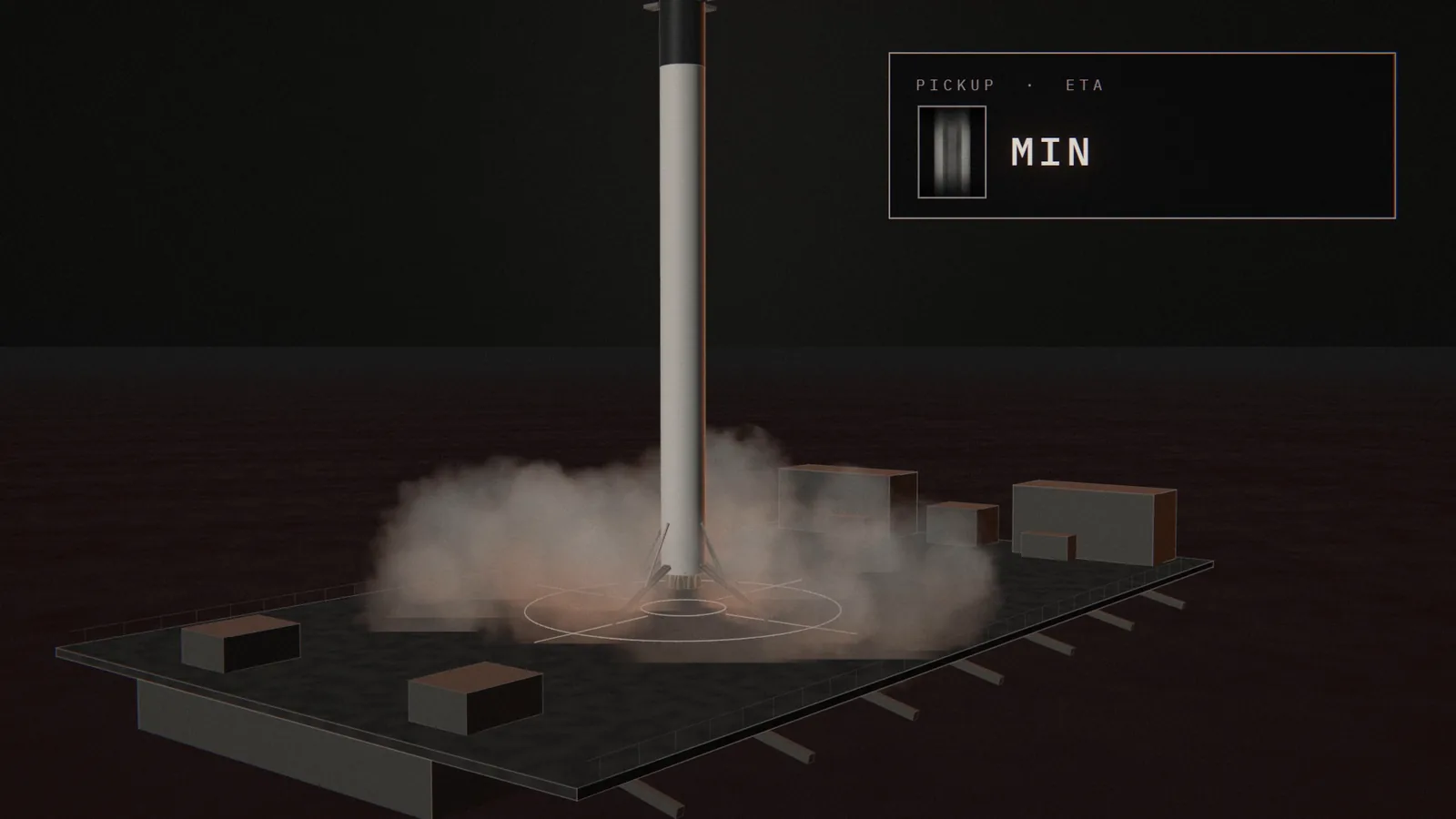
A static fire on the launch mount.
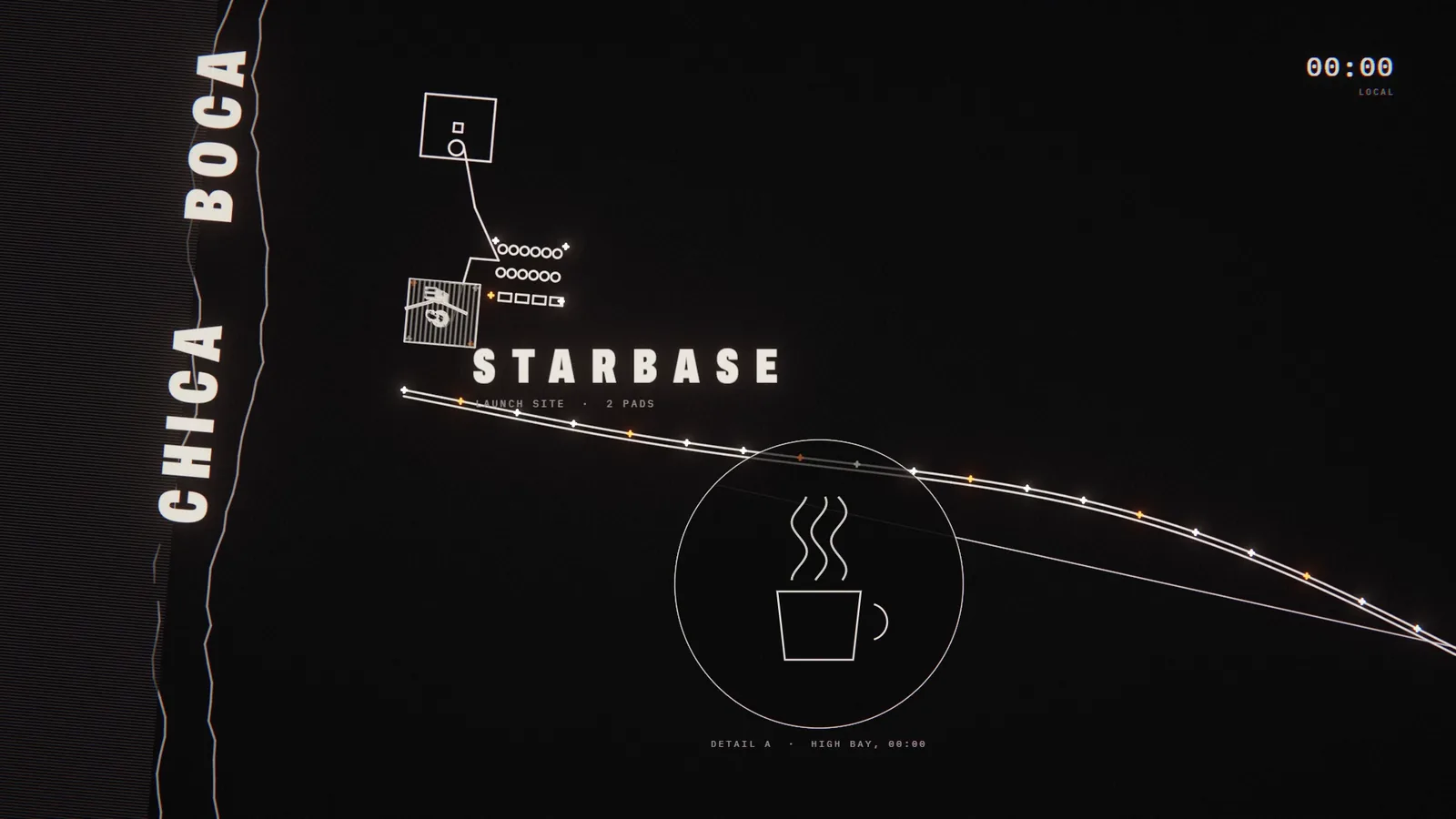
The launch site drawn as a line plan.
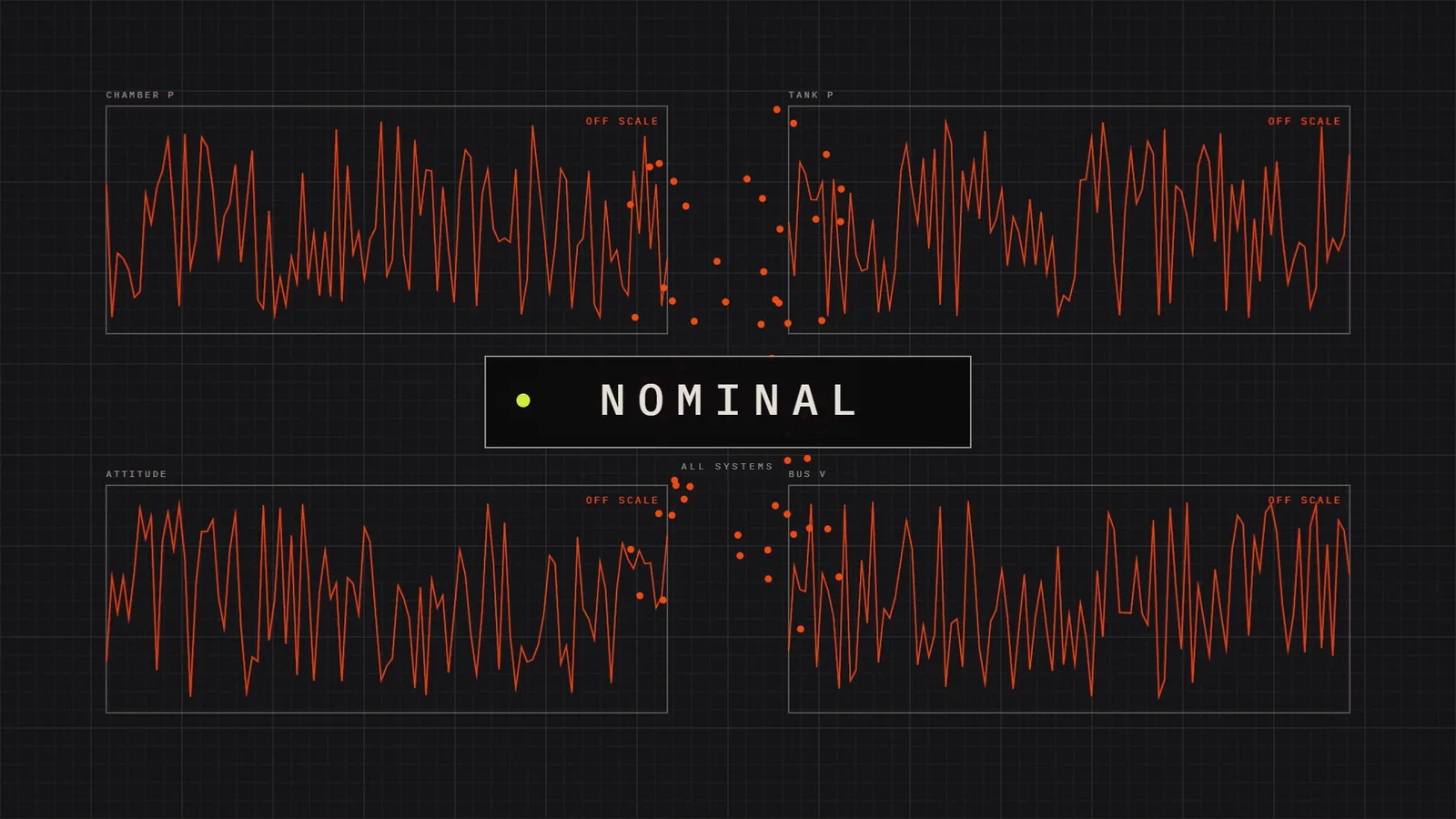
Telemetry used as an animation element.

Typography built from the engine layout.
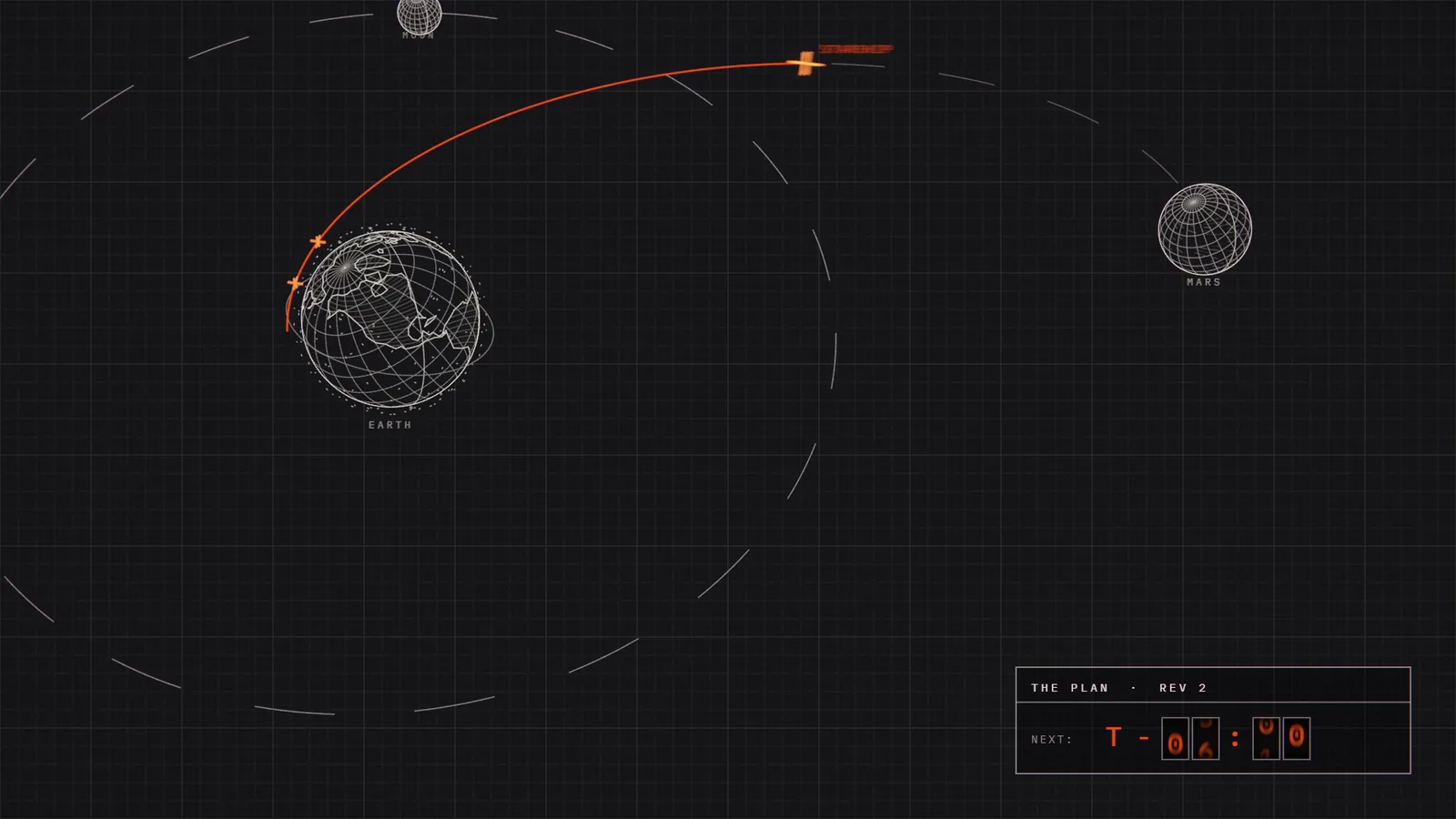
An orbit drawn by its marker.
01 / The system
From a spec to a frame.
- 01Specs
Every vehicle starts as data: one file per vehicle holding every dimension its model uses.
spacex/specs/ - 02Parts
Functions turn that data into geometry: revolved bodies, flaps, grid fins, engine bells and clusters.
spacex/parts/ - 03Vehicles
Assemblies posed from plain state (flap angles, attitude, engine states) and never rebuilt per frame.
spacex/vehicles/ - 04Scenes
38 shots choreograph vehicles, typography and telemetry against the lyrics.
spacex/timeline.ts - 05Timing
Shots are addressed by lyric words, beats and named events from frozen timing data, never by typed seconds.
spacex/show/song.ts - 06Frame(t)
Every frame is a function of song time alone, so frames can be rendered in any order.
engine/engine.ts - 07Render
Headless Chrome renders each frame offline as the average of 12 sub-frames for motion blur; ffmpeg encodes the master.
scripts/render.ts - 08Film
8,158 frames at 1920 × 1080 and 60 fps, cut to the song.
02 / Timing
Cut to the song.
The edit follows the song’s structure. Each shot starts and ends on a lyric word, a beat or a named event in the timing data, not on typed seconds.
- Intro
- Verse
- Pre-chorus
- Break
- Chorus
- Tag
- Outro
- Tail
03 / Listening to the song
Turning audio into data.
Before any picture, the song had to become numbers. The first problem was time itself: an MP3 starts with a few milliseconds of encoder padding (1,105 samples here), and browsers skip it. If the analysis doesn’t skip it too, every cut lands a little late. So the audio is decoded the same way a browser plays it, and the timing data is measured from that.
A source-separation model (Demucs) splits the song into vocals, drums, bass and everything else. Beats come from the drum track: a phase-locked loop follows the drum hits, then a smooth curve is fit through them. Half the beats land within about 2 ms of an actual drum hit, and 90% within 9 ms.
The tempo isn’t constant. It drifts from about 103 BPM up to 105.5 BPM by the end, and there’s one two-beat bar where the song stops. So nothing in the film uses BPM math. Every cut points at an actual beat in the list. Words are placed by forced alignment, which matches the known lyrics to the vocal track, and then cross-checked against a speech-recognition pass.
| From the song | Count | Used for |
|---|---|---|
| Beats / downbeats | 236 / 59 | Where cuts land |
| Words (with syllable timing) | 294 (82) | Typography that appears as each word is sung |
| Kicks · snares · hi-hats | 144 · 163 · 375 | Hits, flashes and camera shake |
| Named moments | 21 | Ignition, drops, stops, the final countdown |
| Loudness envelopes | 8 bands and stems at 100 fps | Anything that should breathe with the music |
04 / A rocket from numbers
Specs, not sculpting.
Rockets are mostly round, so each body is a profile: radius as a function of height, built from cylinder, cone and ogive segments, then spun around its axis. Flaps, grid fins, legs and engines attach at a height and an angle on that body. Each vehicle names its version, so Starship here is Block 2, and every dimension lives in one spec file.
One spec produces three things from the same numbers: line art for the blueprint shots, a mesh for the shaded shots, and constants for the shaders, so plumes and heat effects start exactly where the engines are. Moving parts are just rotations applied to finished geometry, so flipping a flap never rebuilds the rocket.
Every vehicle got a model sheet before it went into a scene, and each pass found something. Weld lines came out dashed, because their direction was computed from a coordinate that wraps around at 360°. Engraved shading lines closer than 6.5 px apart turned into noise. The nose tip was too sharp at 1.0 m radius, so it became 1.5 m.
05 / Three looks, one model
From blueprint to cinema.
The same model renders three ways: a flat blueprint with dimension lines, an engraved look shaded by hatching that follows the tank rings, and a cinematic look with brushed steel and glowing exhaust.
Going from blueprint to 3D is a camera move, not a cut. The shot starts with an extremely narrow lens, which makes the view almost perfectly flat, then widens the lens while moving the camera in so the rocket stays the same size on screen. The drawing turns into a 3D shot in one continuous move.
06 / Rendering it
Every frame from scratch.
Because each frame depends only on the song time, frames can be rendered in any order, in pieces, and still join perfectly. Fast motion would strobe at 60 fps, so each frame is the average of 12 sub-frames spread across a fifth of the frame time. That’s a real motion blur, like a camera shutter.
The film was rendered on a laptop’s integrated GPU, section by section, without audio: 0.79 s per frame on average, about 1.8 hours of GPU time. The sections were cut on exact frame boundaries, joined without re-encoding, and the song was added once at the end so there are no audio seams. I checked every seam frame against the review render; the worst difference was 1.5 out of 255 brightness levels.
The master is 1920 × 1080 at 60 fps, H.264 with the colour space tagged correctly, 988 MB for 2 minutes 16 seconds. During the render, the laptop went to sleep and the GPU dropped out mid-render, so the last three sections were re-rendered in short pieces.
Vehicles as code
The vehicles, from the film’s own code.
Each model is the film’s vehicle geometry, exported once for the browser: the same specs and parts, without the film’s renderer. One stage, one model at a time. The figures beside each model are SpaceX’s published values.
- Diameter
- 9 m
- Super Heavy engines
- 33
- Starship engines
- 6
Modeled on: Second generation (V2)

Starship on top of Super Heavy: the full launch system.
Drag to rotate; with a mouse, drag up or down to look from above or below. In Components, select a part.
The film
Spaceflight, Rendered.
Credits
Built on the open-source pdoom-video engine ↗ by Giacomo Magnanini (MIT license), which provides the renderer, post-processing, motion blur and offline export. The SpaceX layer was developed for this project: vehicle specs, parts and models, the 38 shots, the typography and the timing data for this song. The song is not my composition; full credits are in my portfolio PDF.
Continue exploring.
← Back to Selected Builds