Selected work · 14
JUPITER.
Searching calibrated Cassini images for Jupiter lightning candidates with an explainable computer-vision pipeline, published-event validation, and a structured human-review workflow.
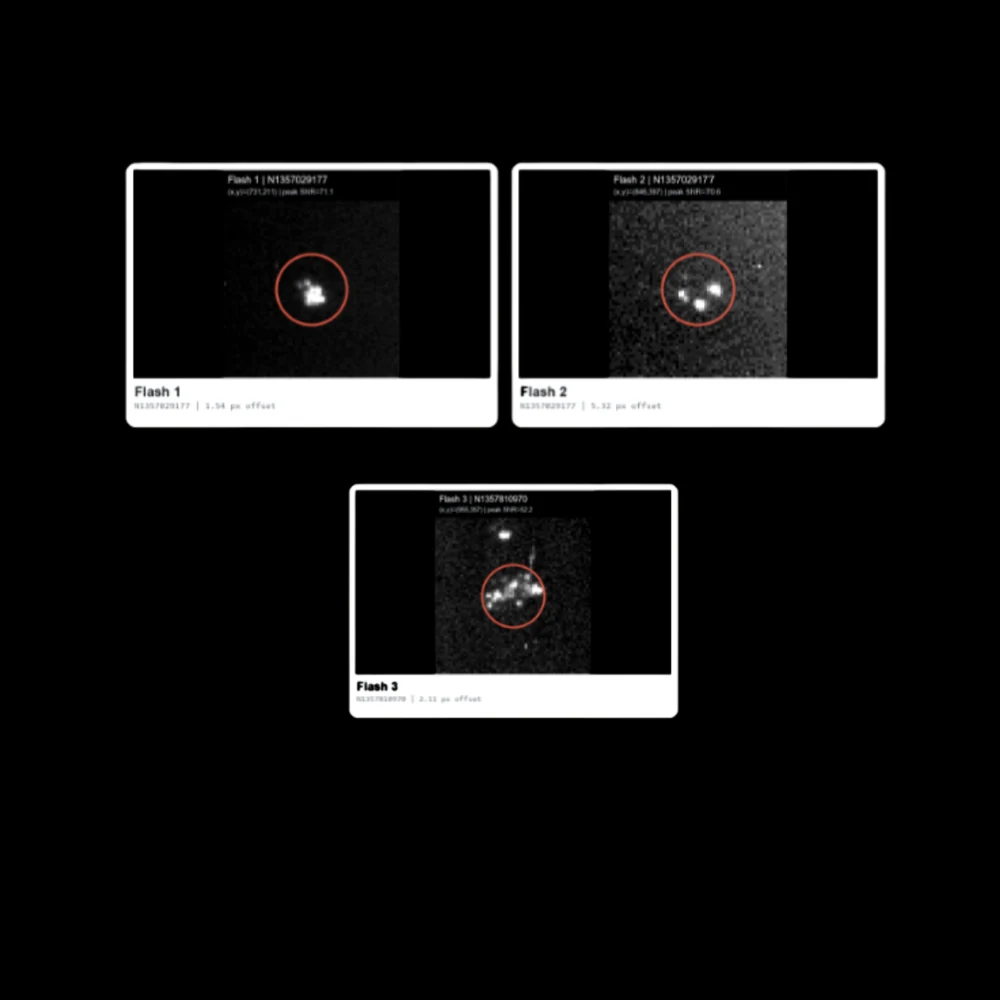
- Instrument
- Cassini ISS NAC · H-alpha
- Search scope
- 221 images · 9 date windows
- Validation
- 6 of 6 published marks within 8 pixels
- Status
- Candidate review · no new-lightning claim
Images & documentation
Inside the project.
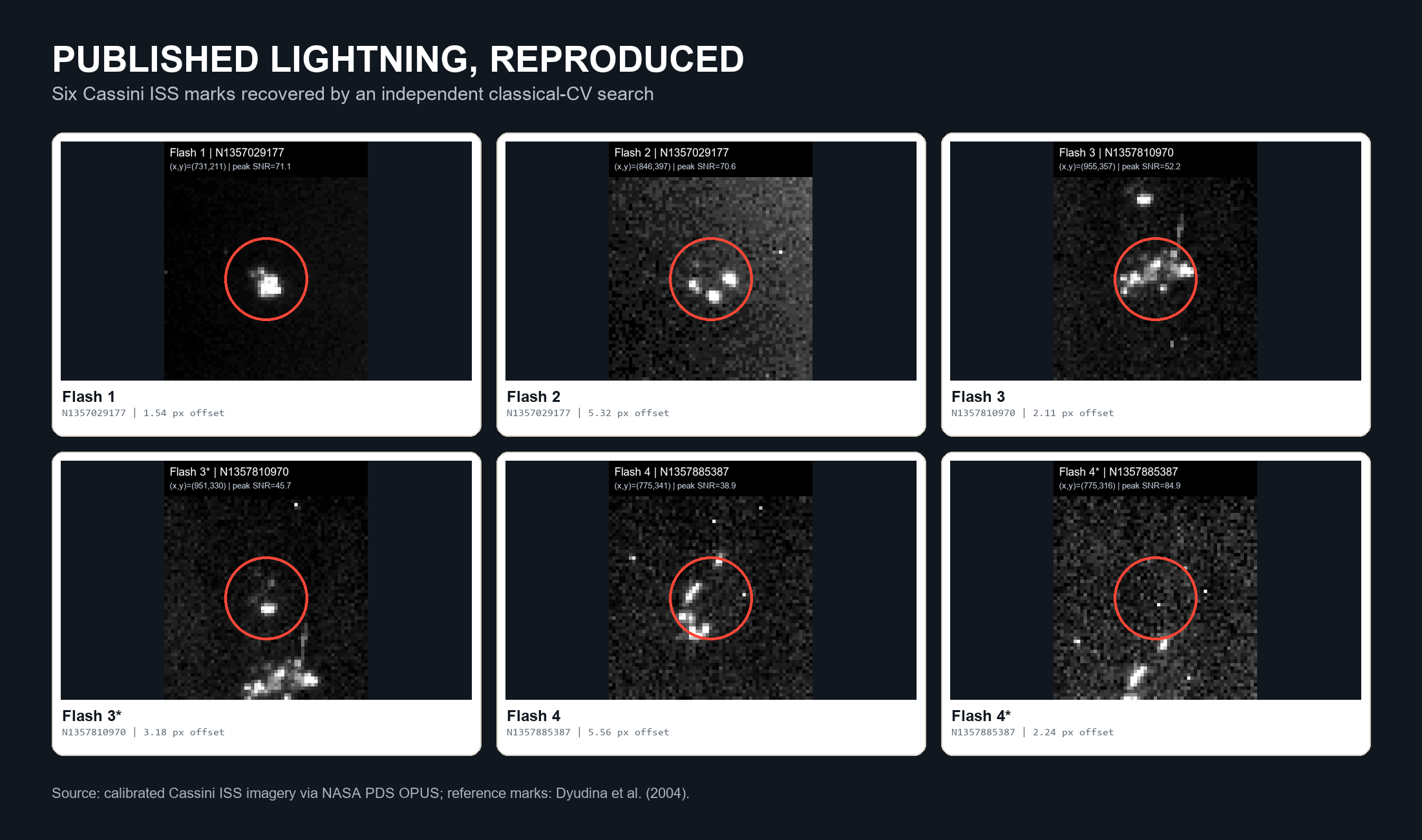
Image evidence for recovery of the published Cassini lightning marks.
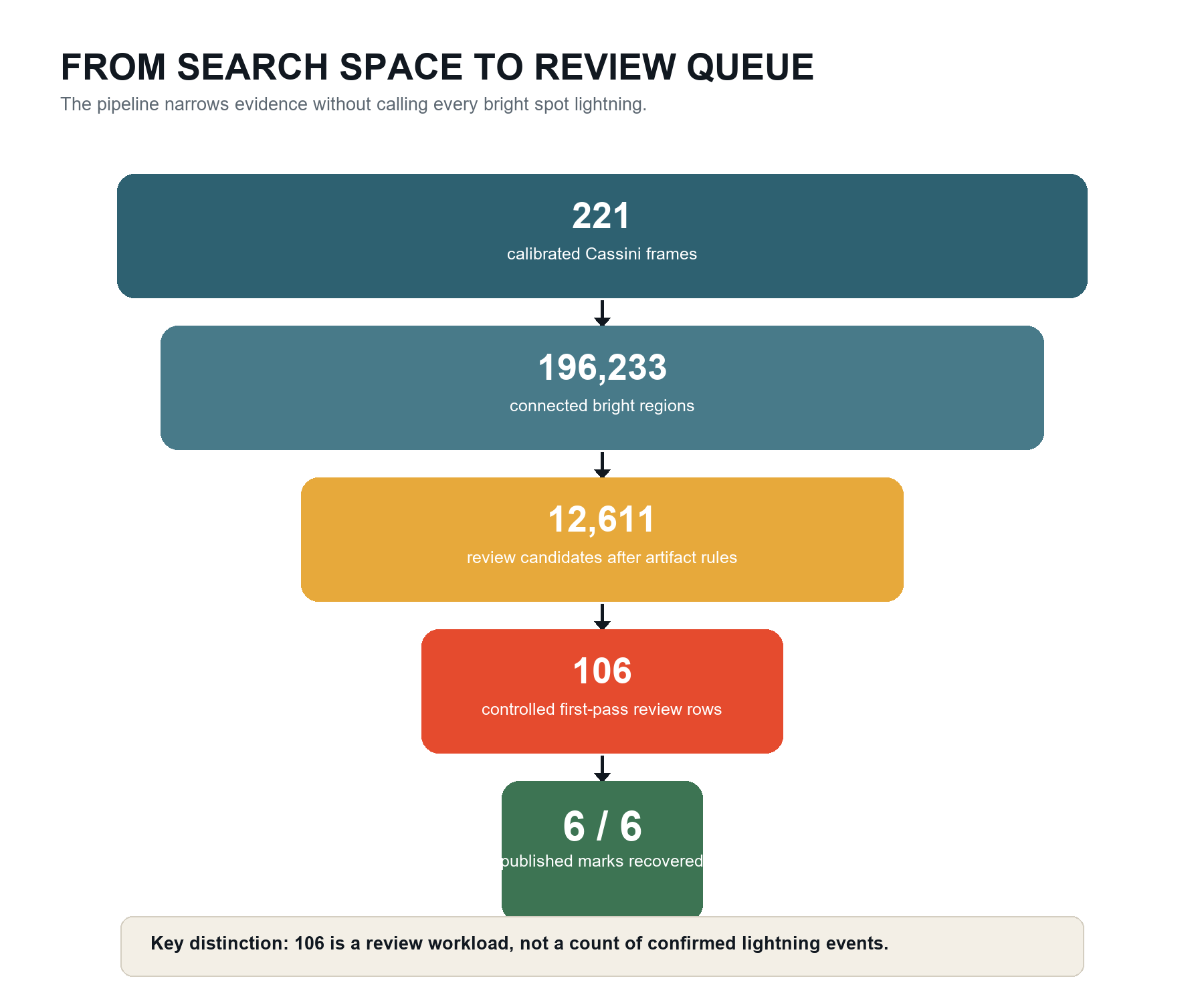
Raw bright regions are filtered into a review pool, not a discovery catalog.
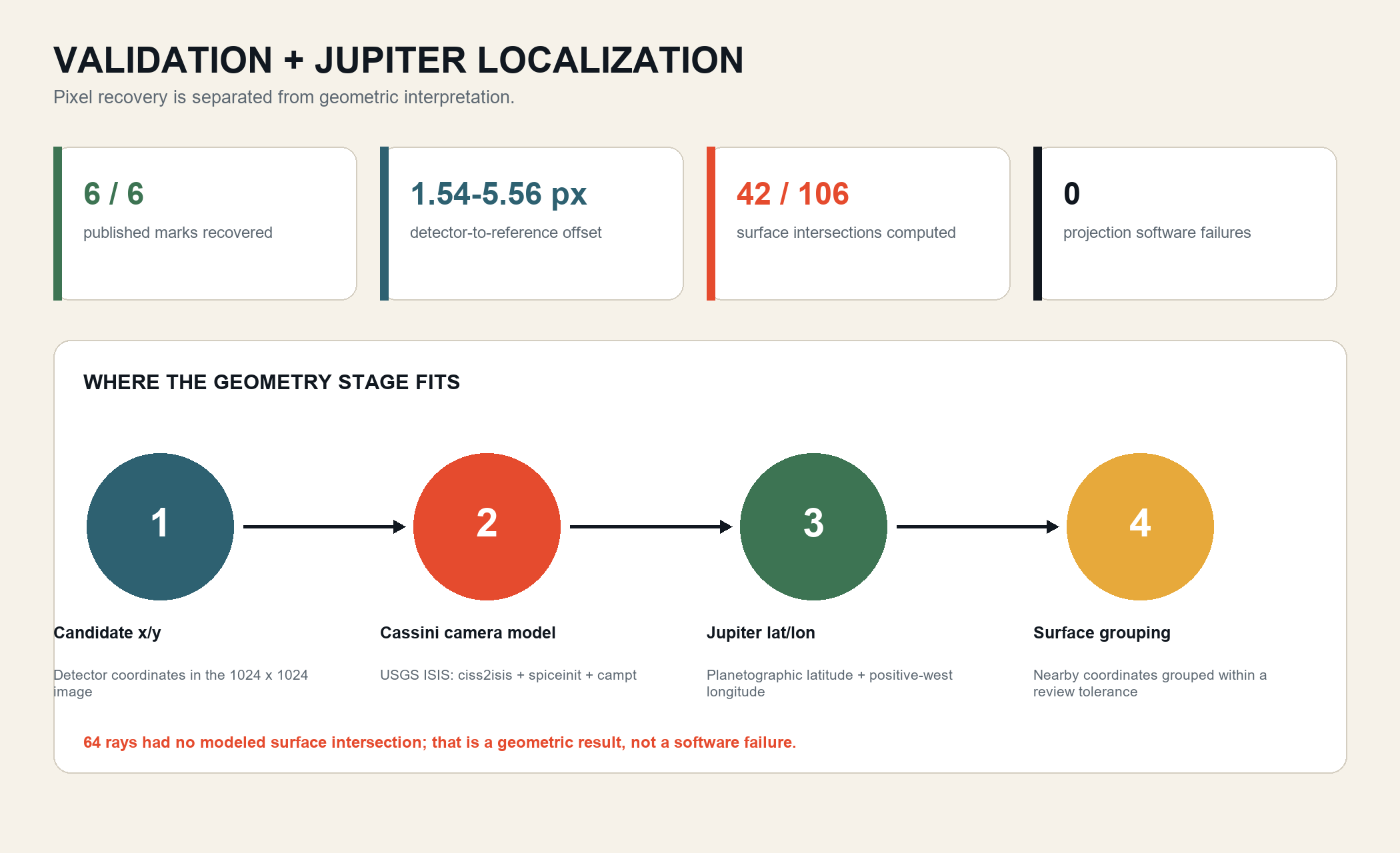
Pixel recovery and derived surface geometry are separate checks.
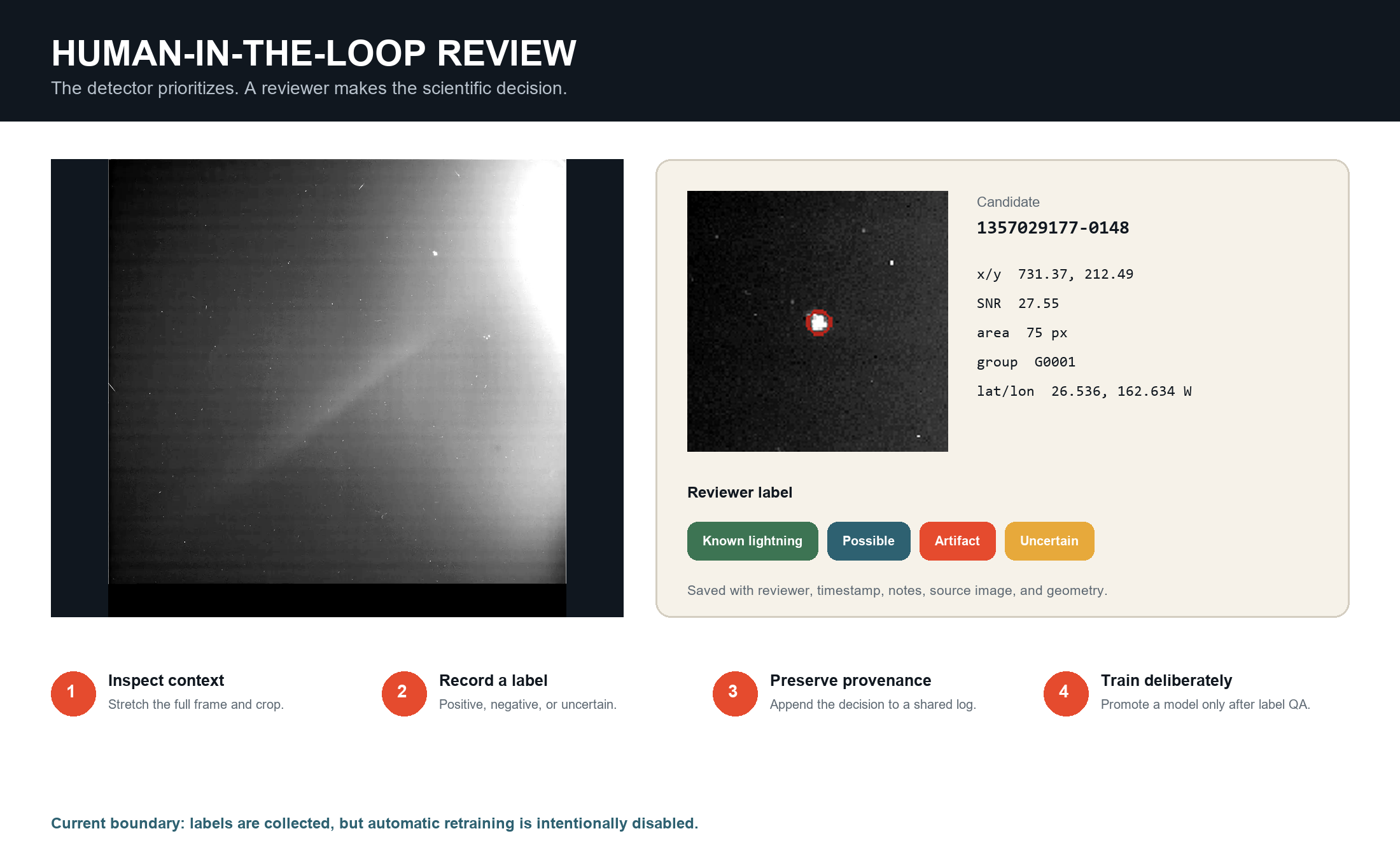
Structured review separates likely signals, artifacts and uncertain cases.
Method, step by step
From images to evidence.
- 01
Read calibrated images
Cassini ISS NAC / H-alpha archive products.
- 02
Estimate background
Contrast stretch and smooth local-background subtraction.
- 03
Find bright regions
Connected regions above residual SNR 7.
- 04
Measure & filter
Size, shape, sharpness and SNR; flag tiny pixels, streaks and edges.
- 05
Link nearby frames
Candidate proximity within 85 pixels and 12 minutes is a review aid.
- 06
Validate & review
Match published marks; inspect temporal behavior, geometry and human labels.
Evidence, explained
Where the review load comes from.
Review candidates by date window. These are artifact-filtered candidates, not counts of confirmed lightning.
Evidence, explained
From 196,233 bright regions to a reviewable queue.
Different stages answer different questions. A smaller queue is easier to inspect but is not automatically more scientifically accurate.
| Stage | Count | Interpretation |
|---|---|---|
| Raw connected regions | 196,233 | Broad search, including noise and artifacts |
| Filtered candidates | 12,611 | 6.43% of raw regions survive review filtering |
| First-pass review plan | 106 | Curated examples, not a random sample or precision estimate |
| Published validation marks | 6 / 6 | Known-reference recovery within eight pixels |
Evidence, explained
The detector, without a black box.
These are explicit image-processing rules implemented in Python/NumPy/Pillow.
| Stage | Method | Purpose |
|---|---|---|
| Normalize | 2nd–99.8th percentile contrast stretch | Bring out weak image structure |
| Background | 18 px Gaussian estimate and subtraction | Separate local bright structure from broad background |
| Noise | Median absolute deviation | Robust residual noise scale |
| Detection | SNR ≥ 7; eight-neighbor components | Collect bright connected regions |
| Measurements | Centroid, area, integrated/peak SNR, sharpness, elongation | Preserve inspectable evidence |
| Review gate | Area ≥ 3 px, peak SNR ≥ 8, no artifact flags | Deprioritize hot pixels, sharp cosmic rays, streaks and borders |
| Temporal linking | Within 85 px and 12 minutes | Rank repeated candidates for review, not confirmation |
| Future ML | Audited positive/negative labels; held-out observation sequences | Compare a learned model against the fixed baseline |
Evidence, explained
Date-by-date evidence.
Counts taken from the saved detector summary.
| Date | Images | Raw regions | Review candidates | Known matches |
|---|---|---|---|---|
| 2000-12-31 | 12 | 5035 | 565 | 0 |
| 2001-01-01 | 23 | 9447 | 1094 | 2 |
| 2001-01-04 | 17 | 3888 | 483 | 0 |
| 2001-01-05 | 22 | 4784 | 573 | 0 |
| 2001-01-08 | 54 | 115644 | 6310 | 0 |
| 2001-01-09 | 11 | 7491 | 370 | 0 |
| 2001-01-10 | 26 | 5880 | 472 | 2 |
| 2001-01-11 | 31 | 6737 | 418 | 2 |
| 2001-01-13 | 25 | 37327 | 2326 | 0 |
Recover known events first
The core question is whether an automated pipeline can recover known published lightning locations in calibrated Cassini ISS H-alpha images. Published marks provide a validation reference before unmatched candidates are considered for further investigation.
An explainable detector
The current detector uses classical computer vision in Python rather than a trained deep-learning model. It estimates local background, detects connected bright regions, and records location, area, signal-to-noise ratio, sharpness and elongation.
Review promotion requires at least three pixels, peak SNR of at least 8 and no artifact flags. Nearby-frame linking helps prioritize inspection but does not prove a persistent lightning event. The ranking score is not a calibrated probability.
Saved search scope
| Stage | Count | Meaning |
|---|---|---|
| Calibrated frames | 221 | Nine date windows |
| Raw bright regions | 196,233 | Broad first-pass detections |
| Review candidates | 12,611 | After artifact filtering |
| Published marks recovered | 6 / 6 | Within an 8-pixel radius |
| Curated first-pass queue | 106 | For structured human review |
The processed date windows span December 31, 2000 through January 13, 2001. The saved known-match offsets range from 1.54 to 5.56 pixels. Recovery of six reference marks demonstrates that check only; it does not establish general precision or recall.
Geometry is a separate check
The later saved geometry-validation report covers 106 queue rows: 42 surface coordinates computed, 64 with no surface intersection and zero projection failures. All six published-match candidates have projected coordinates.
Those coordinates are derived metadata from the ISIS camera model. The published reference validates image-pixel recovery, not these latitude/longitude estimates. Coordinate conventions and projection provenance must remain attached, and a shared surface group is not proof of the same storm.
Human review before learning
The 106-row first-pass plan includes six reference positives, 30 temporal-persistence checks, 20 likely artifact examples, 20 strong single-frame checks and 30 lower-priority rows. Reviewers record yes, no or uncertain decisions to build an auditable label set.
A learned classifier remains dependent on sufficient reviewed positive and negative examples. Unmatched review candidates are not confirmed new lightning.
Evidence & limitations
The page summarizes saved detector outputs and review documentation, not a fresh pipeline run. Temporal consistency, artifact rejection, human labels and geometry interpretation remain essential before making scientific discovery claims.
Public source repository
Read the algorithm.
Implementation, configuration, tests and methodology.
Explore source code ↗Explore more of the work.
← Back to Selected Builds